
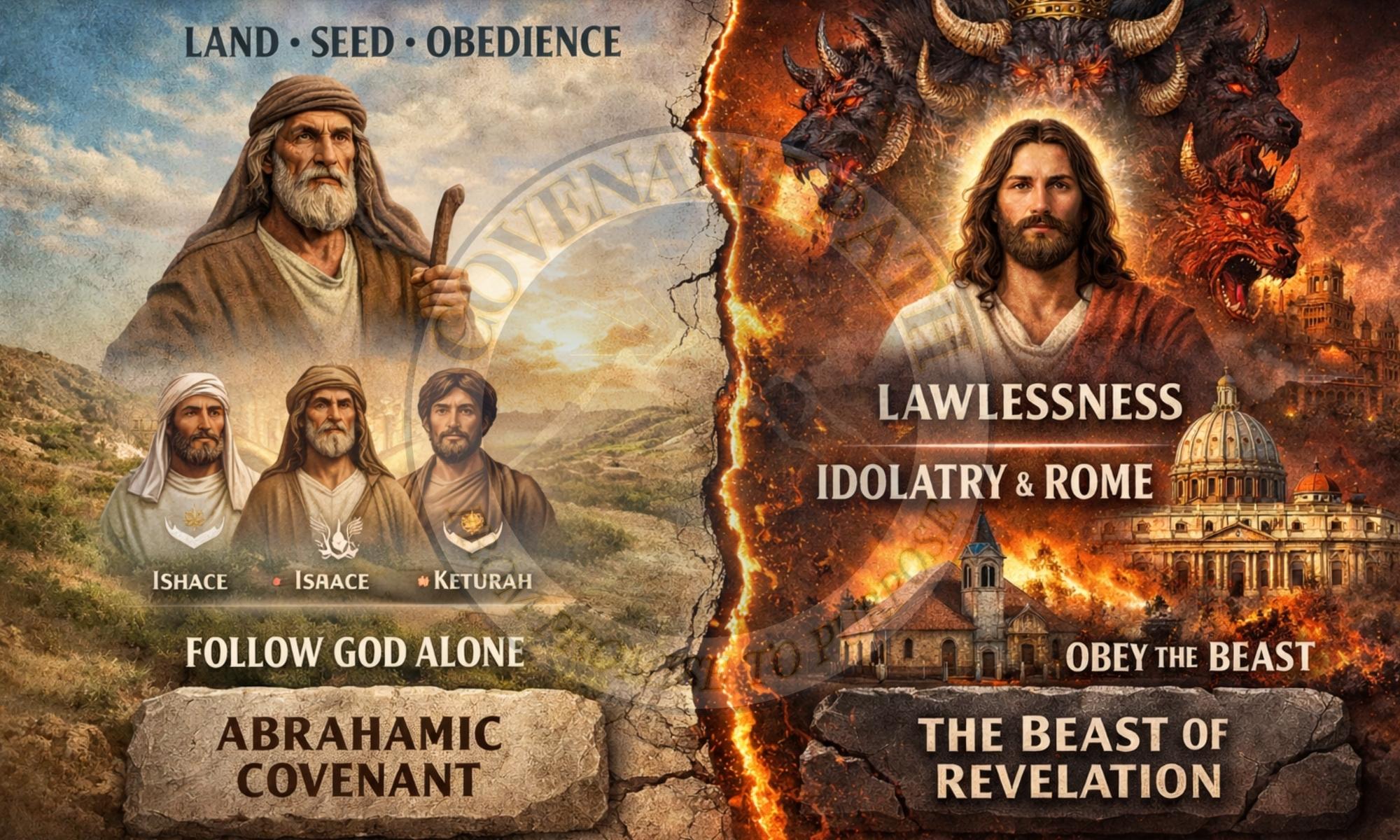
Abraham Sets the Pattern God Never Reverses
God begins with Abraham’s Covenant and concludes with the Book of Revelation – with a command, a land, and obedience. Abram leaves his father’s house and goes to Canaan because God instructs him to do so. Accordingly, covenant identity forms through obedient movement toward God’s instruction, not through belief detached from action. Therefore, Abraham’s departure establishes the permanent pattern by which all later claims must be judged.
Scripture binds three elements together from the start:
- Land (a real place promised by God),
- Seed (a real family with real roles),
- Obedience (a lived response to God’s command).
God never abstracts these elements. God never spiritualizes them away. Thus, any theology that dissolves land, seed, or obedience breaks faith with Abraham’s covenant.
The Sons of Abraham Share Blessing but Carry Distinct Roles
God blesses all the sons of Abraham. Scripture assigns different functions, not interchangeable identities.
- Isaac’s line carries covenant continuity tied to land and instruction.
- Ishmael’s line receives blessing, nationhood, and multiplication.
- The sons of Keturah spread among the nations.
Accordingly, unity does not require sameness.
Blessing does not erase assignment. Therefore, Israel’s role emerges not as supremacy but as custodianship—guarding the way Abraham walked so the nations can see how God dwells with humanity.
Israel as Priestly Custodian, Not Replacement Target
From Isaac and Jacob comes Israel, entrusted with preserving how to walk with God.
Israel does not replace Abraham’s other sons. Instead, Israel protects covenant instruction—commandments, worship, and holiness.
Scripture assigns Israel to:
- Guard God’s commandments,
- Preserve correct worship,
- Maintain the place where God chooses to dwell.
Protecting Israel protects the covenant pathway Abraham established. Attacking or replacing Israel dismantles the priestly structure God ordained.
The Land and the Temple Anchor God’s Dwelling
- God chooses place deliberately.
- Canaan anchors the covenant geographically.
- The Temple anchors God’s dwelling ritually.
The Temple does not limit God. The Temple hosts God’s presence where holiness, priesthood, and obedience converge. Accordingly, Scripture never declares the Temple obsolete—only defiled, destroyed, and promised for restoration.
Spiritualizing the land and dismissing the Temple dissolve Abraham’s covenant into abstraction.
Scripture never authorizes that move.
God Walks with Humanity Without Becoming Human
The Abrahamic record shows God walking with humanity directly.
- God speaks with Abraham without incarnation.
- God visits his tent without embodiment.
- God dwells among Israel without becoming a man.
Therefore, Scripture never requires God to become human in order to dwell with humans.
Covenant obedience—not deification of flesh—creates proximity to God.
Any claim that God needed to become a man contradicts the Abrahamic pattern God Himself established.
Revelation Warns of a System that Abandons Abraham’s Path
When Book of Revelation warns of a global deception, it does not invent new categories. John speaks in Abrahamic and prophetic language: covenant, land, obedience, worship, and kingship.
Revelation exposes a system that:
- Claims Abraham’s God,
- Uses Scripture’s language,
- Yet removes obedience, land, Israel’s role, and the Temple.
This warning does not point forward to innovation. It points backward to abandonment of Abraham’s covenant.
The Beast: Secular Power Detached from God’s Law
Revelation’s Beast represents authority arising from the nations—rule without submission to God’s instruction. Scripture already identifies such power as kingdoms that legislate apart from God.
- Christianity does not resist this authority.
- Christianity blesses it, partners with it, and thrives under it.
- Accordingly, Christianity functions as the religious legitimizer of lawless power.
This alignment contradicts Abraham’s covenant, which ties blessing to obedience, not dominance.
The Antichrist: Anti-Covenant, Not Anti-Religion
Scripture defines opposition to God as opposition to His covenant order. Accordingly, antichrist means against God’s anointed structure—land, obedience, Israel’s role, and God’s oneness.
Christianity fulfills this role by:
- Abolishing commandments Abraham obeyed,
- Replacing the land with abstraction,
- Supplanting Israel’s priestly function,
- Declaring the Temple unnecessary,
- Introducing mediated worship.
Within this system, Jesus Christ functions as the mechanism by which covenant obedience dissolves:
- Commandments become “fulfilled away,”
- Worship redirects from God alone,
- Incarnation replaces covenant dwelling.
Thus, Jesus—as presented and worshiped by Christianity—fulfills the anti-covenant role Scripture warns against.
The Image and the Mark: Allegiance Replaced
Revelation’s image does not require a statue. It requires theological elevation of humanity.
- Christianity elevates a human figure into divine status.
- That elevation redirects worship away from God’s oneness.
The mark signifies allegiance in thought and action. Christian doctrine reshapes belief by dismissing commandments. Christian practice reshapes behavior by abandoning Abraham’s walk. Accordingly, allegiance shifts from covenant obedience to religious abstraction.
Babylon: Sanctified Betrayal of Abraham’s Covenant
Revelation’s Babylon uses holy language while violating covenant order.
Scripture already describes this as spiritual adultery—claiming God while abandoning His instructions.
Christianity fits this profile precisely:
- Abraham’s God without Abraham’s obedience,
- Scripture without covenant,
- Blessing without land,
- Worship without the Temple.
This system does not oppose God openly. It redefines Him, which Scripture treats as the greatest deception.
The Final Measure: Walk as Abraham Walked
Scripture defines faith before religion exists.
Abraham believes God and acts accordingly—leaves, walks, dwells, obeys, and inherits.
- Therefore, any claim to Abraham that refuses his walk stands exposed.
- The sons of Abraham do not need replacement theology.
- They need restoration to the first covenant.
Final Conclusion
Abraham’s covenant binds land, obedience, and family roles together permanently.
Israel preserves the priestly pathway.
The Temple anchors God’s dwelling.
God remains one and unmediated.
Christianity dissolves each of these elements while claiming Abraham’s God.
Revelation warns that such a system would arise, dominate, and sanctify lawlessness.
Accordingly, Christianity fulfills the role of the Beast’s religion, and Jesus—within that system—functions as the antichrist mechanism that leads humanity away from Abraham’s path.
The call remains unchanged:
Return to Abraham.
Walk as he walked.