![Covenant Path logo featuring [brief visual cue—e.g., stylized mountain and light motif] representing a global Torah-based faith journey.](https://i0.wp.com/covenantpath.faith/wp-content/uploads/2025/09/cropped-covenant-path-logo.png?fit=512%2C512&ssl=1)
Beginning Where Scripture Begins
Any discussion of The Abrahamic Covenant, Rome, and the Question of the Land must begin not with empire, creed, or institution, but with Avraham. Long before political powers, religious systems, or later doctrines shaped history, God called Avraham to walk before Him in faithfulness and obedience. The covenant established with Avraham was grounded in land, family, and blessing, forming the foundation upon which all later covenantal roles and responsibilities were built. To understand how those promises were later challenged, redefined, or set aside, one must first return to where Scripture itself begins—with the call of Avraham and the covenant God made with him.
“Get yourself out of your country, away from your kinsmen and away from your father’s house, and go to the land that I will show you.”
(Genesis / B’resheet 12:1, CJB)
From its first expression, the covenant is geographic, familial, and obedient. God promises Avraham land, descendants, and blessing. That blessing is not confined to a single lineage.
“By you all the families of the earth will be blessed.”
(Genesis / B’resheet 12:3, CJB)
Scripture records blessing and future for:
- Yitz’chak, through whom Israel’s priestly role is assigned
- Yishma‘el, whom God explicitly blesses
- The sons of Keturah, given inheritance and sent east
“As for Yishma‘el, I have heard you… I will bless him, make him fruitful and multiply him greatly.”
(Genesis / B’resheet 17:20, CJB)
No single lineage exhausts the Abrahamic promise. No institution replaces Avraham’s household.
Covenant Roles Are Assigned, Not Replaced
Election in Scripture is functional rather than eliminative.
“If you will pay careful attention to what I say and keep my covenant, then you will be my own treasure from among all the peoples.”
(Exodus / Sh’mot 19:5, CJB)
Israel is chosen for a priestly role among the nations, not to erase other branches of Avraham’s family.
“Then ADONAI your God will restore your fortunes… and gather you again.”
(Deuteronomy / D’varim 30:3, CJB)
Discipline corrects behavior; it does not revoke covenant.
The Temple as a Covenant Center
The Temple served Israel’s priestly function, yet Scripture limits its theological scope.
“Heaven itself, even the heaven of heavens, cannot contain you; so how much less this house I have built!”
(1 Kings / Melakhim Alef 8:27, CJB)
The covenant predates the Temple and outlasts it.
“My house will be called a house of prayer for all peoples.”
(Isaiah / Yesha‘yahu 56:7, CJB)
The Roman Empire Enters the Narrative
66–70 CE: War and Destruction
Judea existed under Roman occupation during the first century. Revolts and internal divisions destabilized the province.
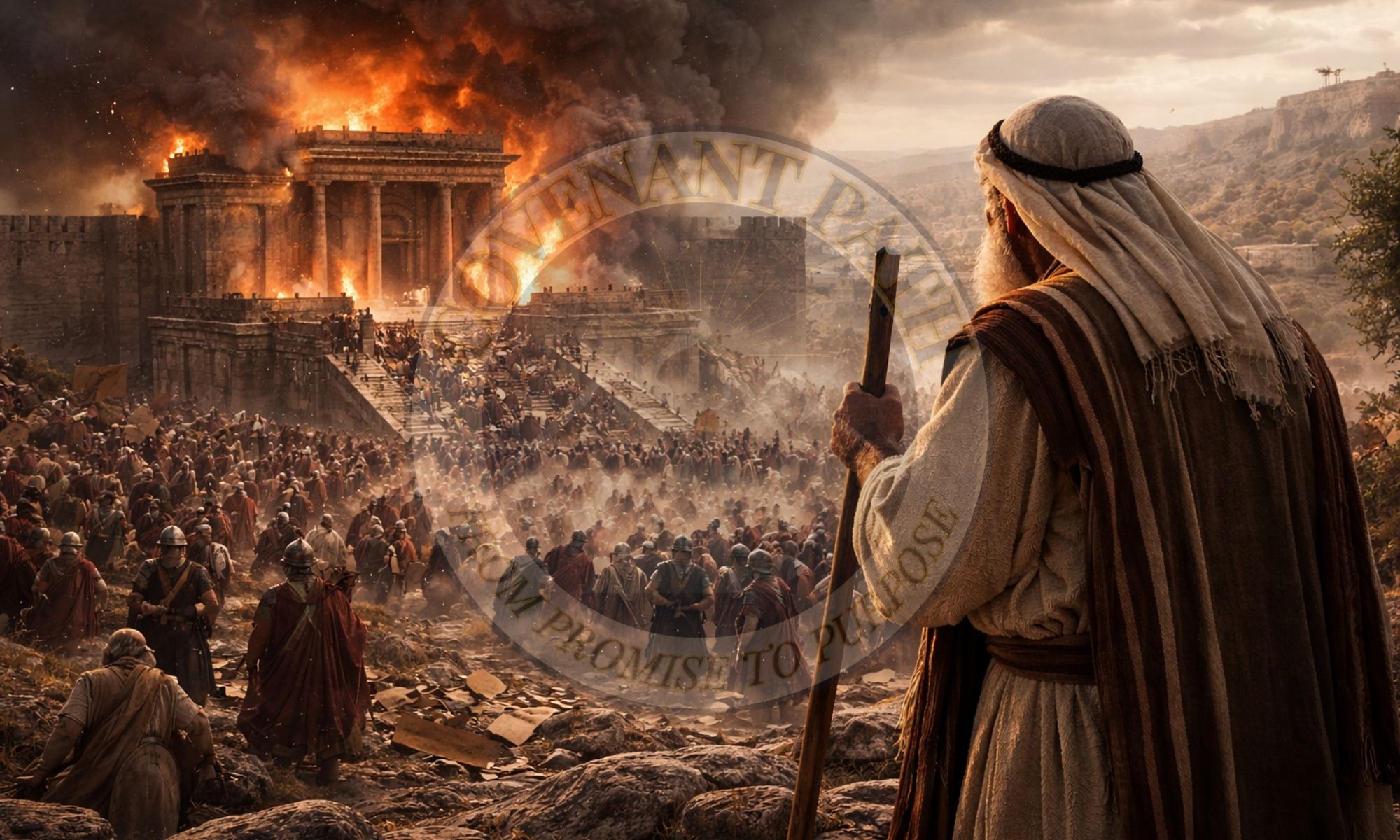
In 70 CE, Jerusalem is besieged and the Second Temple destroyed.
“You will be uprooted from the land you are entering to possess.”
(Deuteronomy / D’varim 28:63, CJB)
Scripture frames this as judgment, not covenant annulment.
70–135 CE: Consolidation and Exile
After the destruction, Rome consolidated control. Jerusalem remained under military authority.
Following the Bar Kokhba revolt:
- Jews are barred from Jerusalem
- The city becomes as a Roman colony
Biblically, this mirrors earlier exiles.
A Parallel Development Without Land
During the same period, a Yeshua-centered movement spread through the Roman world, largely among Gentiles and far from Jerusalem.
Observable developments included:
- Diminished Torah observance
- Reduced centrality of Jerusalem
- Emphasis on belief over obedience
- Non-territorial identity
These shifts preceded imperial adoption.
Imperial Adoption and Its Consequences
313–380 CE
Christianity was legalized, standardized, and later enforced as state religion.
By this point:
- The Temple remained destroyed
- Jerusalem remained inaccessible
- The Land was unrestored
Yet fulfillment was increasingly taught as complete.
“They offer healing when healing is superficial, saying, ‘Peace, peace,’ when there is no peace.”
(Jeremiah / Yirmeyahu 6:14, CJB)
The Abrahamic Land Promise Remains Central
“I have given this land to your descendants.”
(Genesis / B’resheet 15:18, CJB)
“I will give you and your descendants the land where you are now foreigners.”
(Genesis / B’resheet 17:8, CJB)
Exile is temporary discipline.
“I will take you from among the nations… and bring you into your own land.”
(Ezekiel / Yechezkel 36:24, CJB)
When fulfillment is redefined without land, Abraham’s covenant is functionally neutralized.
Messiah in Scripture: Restoration Required
Tanakh defines Mashiach ben-David clearly.
“Here, the days are coming… when I will raise up a righteous Branch for David.”
(Jeremiah / Yirmeyahu 23:5–6, CJB)
“I will take the people of Isra’el from among the nations… and bring them back into their own land.”
(Ezekiel / Yechezkel 37:21–25, CJB)
Why Yeshua Does Not Meet the Davidic Criteria
Applying the Tanakh standard:
- Kingship was not established
- Exile continued
- The Land was not restored
- The Temple was destroyed
“When a prophet speaks in the name of ADONAI, and the prediction does not come true… ADONAI did not speak it.”
(Deuteronomy / D’varim 18:22, CJB)
This conclusion follows Scripture, not hostility.
Divine Oneness and Exclusive Worship
“Sh’ma, Yisra’el! ADONAI our God, ADONAI is one.”
(Deuteronomy / D’varim 6:4, CJB)
“I am ADONAI; that is my name. I will not give my glory to another.”
(Isaiah / Yesha‘yahu 42:8, CJB)
Scripture authorizes worship of God alone.
A Scriptural Warning About Authority
“He will try to change times and laws.”
(Daniel / Dani’el 7:25, CJB)
Authority is tested by restoration, not claims.
Abraham’s House Endures
“As for Yishma‘el, I have blessed him.”
(Genesis / B’resheet 17:20, CJB)
“Many peoples will go and say, ‘Come, let us go up to the mountain of ADONAI.’”
(Isaiah / Yesha‘yahu 60:1–7; Zechariah / Z’kharyah 8:20–23, CJB)
Empire reshapes history; it does not redefine covenant.
Seeking Restoration
“What does ADONAI require of you? To do justice, love kindness, and walk humbly with your God.”
(Micah / Mikhah 6:8, CJB)
The covenant entrusted to Avraham remains tied to land, obedience, and family. Not fulfilled through empire or abstraction.
Covenant Path seeks faithfulness to ADONAI and the covenant He established with Avraham—without replacement, without domination, and without empire.